
Somewhere in your 40s, your body may start sending signals that feel unfamiliar. Your period arrives early one month and late the next. Sleep feels lighter than before. Your mood shifts without much warning. These changes are common, and they usually point to a natural stage of life rather than a health problem.
What Is Perimenopause?
Perimenopause is the stage that leads up to menopause. During this stage, the ovaries slowly make less hormones. They do not stop all at once. Estrogen and progesterone levels rise and fall in an uneven way. This affects the menstrual cycle first. Periods may come closer together, farther apart, heavier, or lighter than before. Ovulation still happens during this stage, just less often. Pregnancy is still possible, even when cycles feel unpredictable.
What Age Does Perimenopause Start?
The timing differs from woman to woman. Most women start this stage in their mid-40s. Some notice changes as early as their late 30s. Others do not notice symptoms until their early 50s. On average, the stage lasts around four years. It can range from a few months to nearly a decade. Genetics and overall health both play a role in this timing.
What Is Menopause?
Menopause is a single point in time. It is not a slow phase. Doctors confirm menopause only after a woman has gone twelve months in a row without a period. There must be no other medical reason for the missing periods. By this stage, the ovaries have made much less hormone. Ovulation has stopped completely. Estrogen and progesterone settle at a new, lower level. They no longer shift from month to month.
When Does Menopause Occur?
Most women in the United States reach menopause between the ages of 51 and 52. The natural range runs from the mid-40s to the late 50s. The exact timing depends on genetics and overall health. Medical history can also play a role, such as past surgery or treatment that affects the ovaries.
Perimenopause vs Menopause Explained
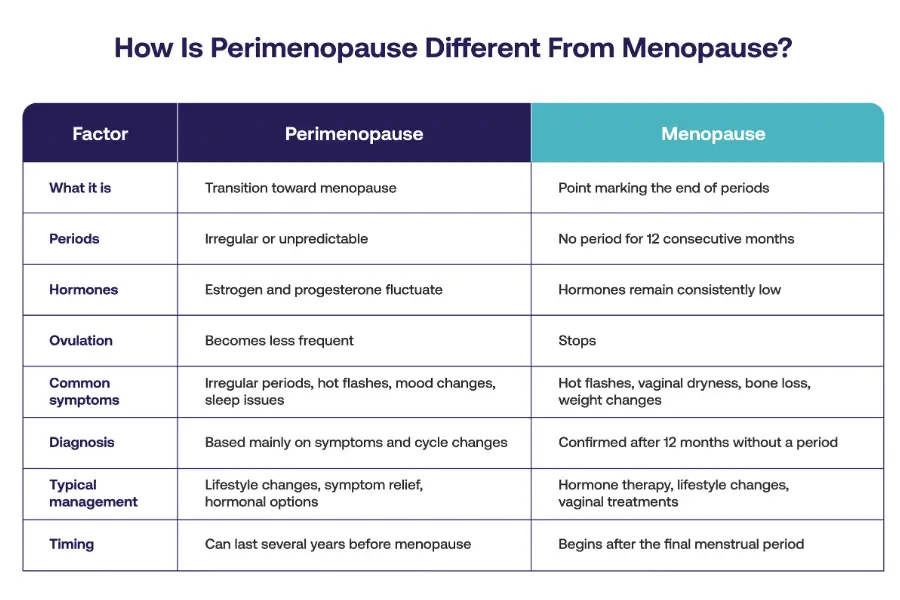
The difference between perimenopause and menopause comes down to two things. The first is whether periods are still happening. The second is how steady hormone levels are. Perimenopause is a changing stage. Menopause is a fixed point that follows it. The tables below compare both stages across hormones, symptoms, causes, diagnosis, and management.
What Are the Hormonal Changes During Perimenopause and Menopause?
Hormone levels shift differently at each stage, and understanding this progression helps explain why symptoms vary in intensity and pattern over time. Here is how estrogen and progesterone behave during perimenopause compared to menopause.
| Perimenopause | Menopause | |
| Estrogen | Rises and falls without a clear pattern. It can spike higher than usual or drop sharply. | Settles at a steady, low level and stays there. |
| Progesterone | Production becomes uneven as ovulation happens less often. | Drops sharply, since ovulation has stopped. |
| Overall pattern | Constant hormone shifts cause symptoms like irregular bleeding and sudden mood changes. | A stable, low baseline replaces the earlier ups and downs. |
This shift, from unpredictable hormone activity to a steady low baseline, marks one of the clearest differences between menopause and perimenopause.
What Are the Common Symptoms of Perimenopause and Menopause?
Both stages share several symptoms, since both involve dropping estrogen. A side-by-side look at menopause vs perimenopause symptoms makes it easier to see why some experiences change once a woman moves from one stage to the other.
| Perimenopause Symptoms | Menopause Symptoms |
| Periods become irregular or unpredictable. | Vaginal dryness causes discomfort during sex. |
| Hot flashes and night sweats occur. | Hot flashes may continue for several years. |
| Mood swings, irritability, or anxiety increase. | Bone density drops, raising the risk of osteoporosis. |
| Sleep problems make it hard to stay asleep. | Metabolism slows, which can lead to weight changes. |
| Fatigue and trouble concentrating appear. | The risk of heart-related health problems rises. |
| Sex drive changes. | Vaginal and urinary comfort continue to shift. |
What Causes Perimenopause and Menopause?
Different factors trigger each stage. This helps explain why some women reach them earlier or later than others.
| Causes of Perimenopause | Causes of Menopause |
| Aging ovaries produce hormones less steadily as the egg supply declines. | Natural aging causes the ovaries to slowly run out of egg follicles. |
| Family history plays a role, since many women enter this stage around the same age as their mothers did. | Surgery to remove the ovaries brings on menopause right away. |
| Smoking is linked to an earlier start to the transition. | Chemotherapy or radiation treatment can damage how the ovaries work. |
| A history of surgery, such as a hysterectomy, can affect blood supply to the ovaries. | Primary ovarian insufficiency occurs when the ovaries stop working before age 40. |
| Autoimmune conditions can affect the ovaries ahead of schedule. | Certain genetic conditions are linked to an earlier start. |
How Do Doctors Diagnose Perimenopause and Menopause?
The difference between menopause and perimenopause also shows up in how doctors diagnose each stage.
| Diagnosing Perimenopause | Diagnosing Menopause |
| No single test confirms this stage with certainty. | Doctors confirm menopause only after the fact, once 12 months pass in a row without a period. |
| Providers review changes in cycle length, flow, and symptoms. | Providers confirm that no bleeding occurred for a full year. |
| Other conditions, such as thyroid disorders, get ruled out first. | Pregnancy and other causes of missed periods get ruled out. |
| Hormone testing, including FSH levels, can support a diagnosis, but results vary widely. | Hormone testing sometimes helps, especially in younger women with early menopause. |
How to Manage Perimenopause and Menopause Symptoms?
Managing each stage well often means changing your approach as your body changes.
| Managing Perimenopause | Managing Menopause |
| Track your cycle so your provider can spot patterns worth discussing. | Consider hormone therapy to ease hot flashes and vaginal dryness. |
| Consider low-dose birth control to regulate periods and reduce hot flashes. | Support bone health with calcium, vitamin D, and weight-bearing exercise. |
| Adjust your lifestyle through regular exercise, balanced meals, and steady sleep. | Use vaginal moisturizers or lubricants to ease discomfort during intimacy. |
| Manage stress with methods like meditation or deep breathing. | Build heart-healthy habits through regular activity and a balanced diet. |
| Ask your provider about antidepressants or hormone therapy for symptoms that persist. | Schedule routine checkups to track bone density and catch new symptoms early. |
When to See a Doctor
Most of what happens during perimenopause and menopause is a normal part of aging, but certain signs are worth getting checked out rather than waiting through. Reach out to a healthcare provider who offer menopause and perimenopause care if you notice any of the following:
- Periods that arrive less than 21 days apart, or bleeding between cycles
- Soaking through a pad or tampon every one to two hours
- Bleeding that lasts noticeably longer than your usual cycle
- Any bleeding after sex, or any bleeding at all after you’ve already reached menopause
- Hot flashes, mood changes, or sleep problems severe enough to disrupt daily life
- New or worsening anxiety, depression, or emotional symptoms that feel out of proportion
- Symptoms that started suddenly rather than gradually, especially before age 40
None of these automatically mean something is wrong, but they’re the kind of changes a provider should evaluate rather than something to self-diagnose. Conditions like fibroids, polyps, thyroid issues, and clotting disorders can all mimic perimenopausal symptoms, and ruling them out is straightforward with the right visit.
Summary
Perimenopause and menopause form two connected stages of the same natural process. Perimenopause brings change and gradual shifts. Menopause marks a steady, clearly defined point that follows it. Once you know where you stand between these stages, along with the causes, symptoms, and management options for each, confusing changes start to make sense.
FAQs About Perimenopause vs Menopause
It often feels like constant worry, restlessness, or sudden nervousness that feels out of character. Some women also notice physical signs, such as a racing heart or tense muscles. Shifting estrogen levels drive these signs.
Premenopause is the entire span of the reproductive years before any menopause-related changes begin. Periods and hormone levels remain regular during this time. Perimenopause is the shorter transitional phase leading up to menopause, marked by fluctuating hormones and irregular cycles.
Yes. As estrogen drops, cholesterol levels often shift in an unhealthy direction. LDL rises and HDL drops. This is one reason heart health monitoring becomes more important during and after menopause.
Yes. Ovulation continues during perimenopause, just less regularly than before. An egg may still release some months, even with irregular or skipped periods. This means pregnancy is still possible.
Shifting estrogen can cause the uterine lining to build up more than usual before it sheds. This often leads to heavier or longer periods, especially in the earlier years of the transition.
Both stages can bring weight changes. Shifting hormones slow metabolism over time. This effect often becomes more noticeable as estrogen levels keep dropping through perimenopause and into menopause.