Somewhere between the Ozempic commercials and the group chat where your cousin swears by her “little pen,” a real question got lost: pill or shot? It’s not a trivial choice, and honestly, most people asking it in Bakersfield aren’t chasing a red-carpet body. They’re tired. Their knees hurt. Their A1C numbers keep creeping up at the worst possible moment, usually right before a holiday.
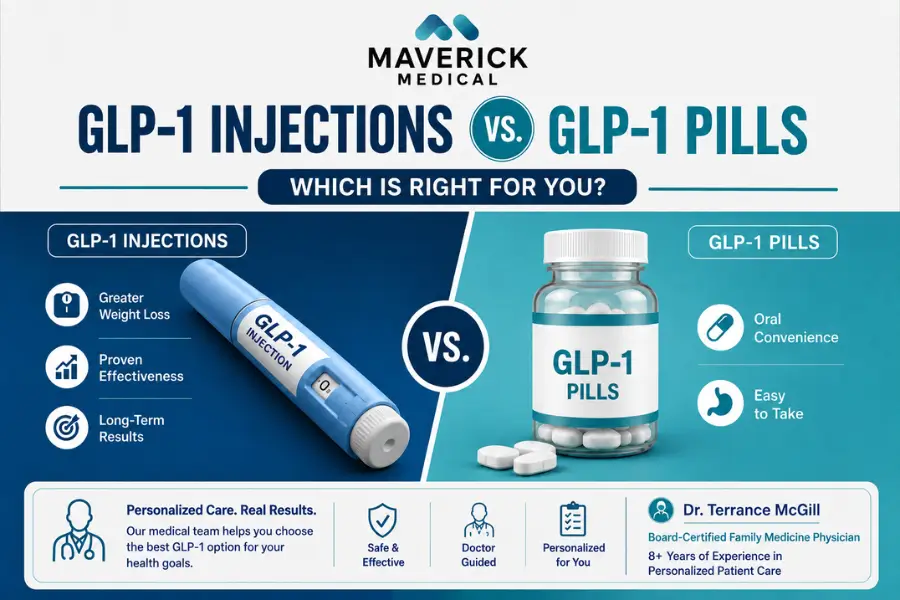
So let’s answer the question plainly before anything else: injectable GLP-1 medications still produce somewhat greater average weight loss than the pill forms, but the gap has narrowed considerably in 2026, and for a lot of patients, the pill’s convenience outweighs a few percentage points of difference. Neither format is universally better. The right one depends on your medical history, your comfort with needles, your budget, and frankly, whether you’ll actually take it consistently for a year or longer.
The Quick Comparison
| Factor | GLP-1 Injections | GLP-1 Pills |
| Common brands | Zepbound, Wegovy, Saxenda | Wegovy (oral), Foundayo (orforglipron), Rybelsus |
| Dosing frequency | Weekly (Zepbound, Wegovy); daily (Saxenda) | Daily |
| Food/water rules | None | Wegovy pill requires an empty stomach; Foundayo has no restrictions |
| Average weight loss | Roughly 15% to 21% depending on drug | Roughly 11% to 17% depending on drug |
| Needle involved | Yes | No |
| Typical monthly self-pay cost | $299 to $399+ | $149 to $349 |
These figures come from manufacturer trial data (Eli Lilly, Novo Nordisk) and are cross-trial estimates, not head-to-head comparisons, so individual results vary quite a bit from patient to patient.
What GLP-1 Medications Actually Do
GLP-1 stands for glucagon-like peptide-1, a hormone your gut already produces after you eat. Medications in this class mimic that hormone. They slow gastric emptying, nudge your pancreas toward better insulin release, and quiet the appetite signals firing in your brain. That’s the whole mechanism, injection or pill. The delivery method changes how the drug enters your bloodstream, not what it’s fundamentally doing once it’s there.
GLP-1 Injections
Injectable GLP-1 treatments have the longer track record, dating back to the mid-2000s when they were developed for type 2 diabetes management before their weight-loss effects became the headline.
- Zepbound (tirzepatide) combines GLP-1 and GIP activity and has shown some of the highest average weight-loss figures in the class, often cited near 20% or more in trial populations.
- Wegovy (semaglutide injection) is typically associated with weight loss in the mid-teens percentage range.
- Saxenda (liraglutide), taken daily rather than weekly, tends to produce more modest results, often cited around 8%.
Injections are self-administered subcutaneously, usually in the abdomen, thigh, or upper arm, and most patients report the process becomes routine within a few weeks.
GLP-1 Pills
Oral GLP-1s used to mean Rybelsus, a diabetes medication with strict morning dosing rules. That’s changed fast.
- The oral Wegovy tablet, cleared for chronic weight management in late 2025, must still be swallowed on an empty stomach, typically first thing in the morning, to absorb properly.
- Foundayo (orforglipron), FDA-approved in April 2026, is a genuinely different thing. It’s the first small-molecule, non-peptide GLP-1 pill, and it can be taken any time of day, with or without food or water. No fasting choreography required.
- Rybelsus remains diabetes-focused rather than a primary weight-management option, though your physician may discuss it depending on your specific goals.
Side Effects: More Alike Than Different
Whether you inject it or swallow it, the class-wide side effect list looks nearly identical, because the underlying mechanism is the same.
- Nausea, especially during the first several weeks of dose escalation
- Constipation or diarrhea
- Bloating, indigestion, or reflux
- Headache and fatigue
- Less commonly: gallbladder issues or pancreatitis symptoms
GLP-1 medications, including Foundayo, carry a boxed warning regarding thyroid C-cell tumors observed in rodent studies; the relevance to humans hasn’t been established, but it’s something Dr. McGill will review with any patient considering treatment, particularly those with a personal or family history of medullary thyroid carcinoma or MEN 2 syndrome.
Cost and Insurance: The Part Nobody Explains Well
This is where a lot of national articles leave Bakersfield patients hanging, because pricing swings wildly depending on coverage.
Self-pay patients might see $149 to $349 monthly for pill forms, versus $299 to $399+ for injections, though manufacturer savings cards can bring commercial-insurance copays down to as little as $25 a month for either format. Medicare Part D coverage for these medications has also been expanding through 2026.
At Maverick Medical Clinic, our team works with patients carrying Aetna, Anthem Blue Cross, Blue Cross Blue Shield, Kern Legacy, Medicare, Medicaid, and Humana, plus self-pay arrangements for those without coverage. We won’t sugarcoat it: prior authorization paperwork can be a slog. That’s exactly the kind of thing our staff handles regularly for Kern County patients.
How to Decide: A Practical Checklist
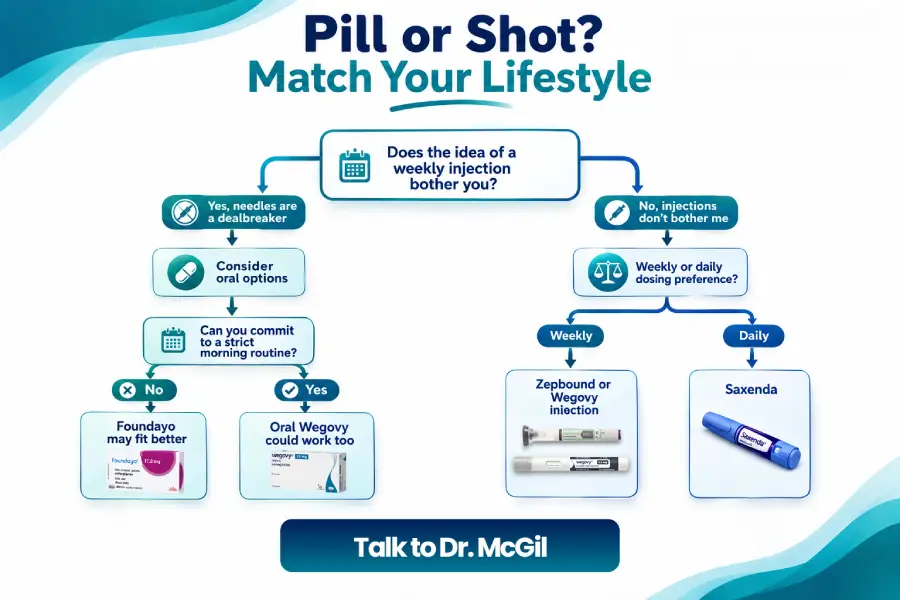
Ask yourself these questions before your appointment. It’ll speed things along considerably.
- Do I have a strong aversion to needles, or is a weekly shot genuinely no big deal for me?
- Am I disciplined enough to take a pill on an empty stomach every single morning, or would a flexible option like orforglipron suit my schedule better?
- What does my insurance actually cover, and which format costs me less out of pocket?
- Do I have other health conditions (thyroid history, gastrointestinal disease, pregnancy plans) that might steer this decision one way or the other?
- Am I managing type 2 diabetes, obesity, or both, since indication and FDA approval status differ by drug?
There’s no prize for picking the “stronger” option if you won’t stick with it. Adherence beats theoretical efficacy almost every time.
Conclusion
Choosing between a GLP-1 pill and a GLP-1 injection comes down to what you’ll actually stick with, not which one looks stronger on paper. Both work through the same hormone pathway, both carry similar side effects, and both need real medical oversight before you start.
Talk to Dr. McGill Before Starting Anything
None of this replaces a real conversation with a physician who knows your labs, your history, and your goals. Dr. Terrance McGill and our care team at Maverick Medical Clinic evaluate each patient individually, factoring in weight, blood sugar trends, cardiovascular risk, and lifestyle before recommending a GLP-1 treatment plan, injection or pill.

Frequently Asked Questions
Pills are close, but injections still edge ahead on average. Foundayo has shown roughly 11% to 12% weight loss at 72 weeks, while injectable options range from about 15% to 21%, depending on the specific drug and dose.
No. Semaglutide (used in Ozempic, Wegovy, and Rybelsus) is a peptide. Orforglipron, sold as Foundayo, is a small-molecule compound that works on the same receptor but isn’t a peptide at all, which is partly why it doesn’t require food or water restrictions.
Sometimes, under medical supervision. Switching protocols vary by medication and dose, so this should always be coordinated with your prescribing physician rather than attempted independently.
It depends on the specific drug and its FDA-approved indication. Some, like Ozempic and Mounjaro, are approved primarily for type 2 diabetes; others, like Zepbound, Wegovy, and Foundayo, carry weight-management approval. Your physician will match the medication to your diagnosis.
Coverage varies significantly by plan and by whether the prescription is for diabetes or weight management. Our team can help verify your specific benefits under Aetna, Anthem Blue Cross, Kern Legacy, Medicare, Medicaid, and other accepted plans.